
Short-term trading is one of the most common trading approaches used in markets today. Often used by forex and stock market traders, short-term trading has become extremely popular with crypto traders as well, due to the high volatility of cryptocurrencies.
Often referred to as “active trading”, short-term trading is based on the short-term price movements. Arguably the most popular short-term approach is day trading, in which trading positions are opened and closed within 24 hours. All strategies, explained below, are based on the intra-day approach.
In accordance with the selected approach, all trading indicators must be customized to fit our approach. Hence, what you won’t do in short-term trading is use the daily or weekly moving averages to determine the price direction. The lower time frames – M5, M15, M30 and H1 – are a must as well.
With that being said, below we take a look at the three most popular short-term trading strategies used by crypto traders on a high-performing and reliable DEX such as the Sparkdex.
All short-term trading strategies, especially in the volatile cryptocurrency market, should be based on the detailed technical analysis. By its nature, short-term traders aim for small to moderate gains as the time frame is very narrow. As such, all levels – entry, take profit, stop loss – must be very precise. For this purpose, Bitspark offers very competitive rates and allows you to trade cryptocurrencies and stablecoins securely.
Trading strategy based on the intra-day support and resistance levels is one of the most popular strategies for short-term traders. In this particular case, technical analysis is based on 20 MA, an hourly chart, and basic horizontal/diagonal trend lines connecting the previous highs and lows.
Picture 1 depicts a BTS/USD trading pair on the Sparkdex. As seen in the chart, the technical analysis has shown that the price action is trapped within a symmetrical triangle, (the green converging lines), thus a breakout is imminent. Furthermore, the 20 MA converges with the triangle resistance, creating a resistance block.
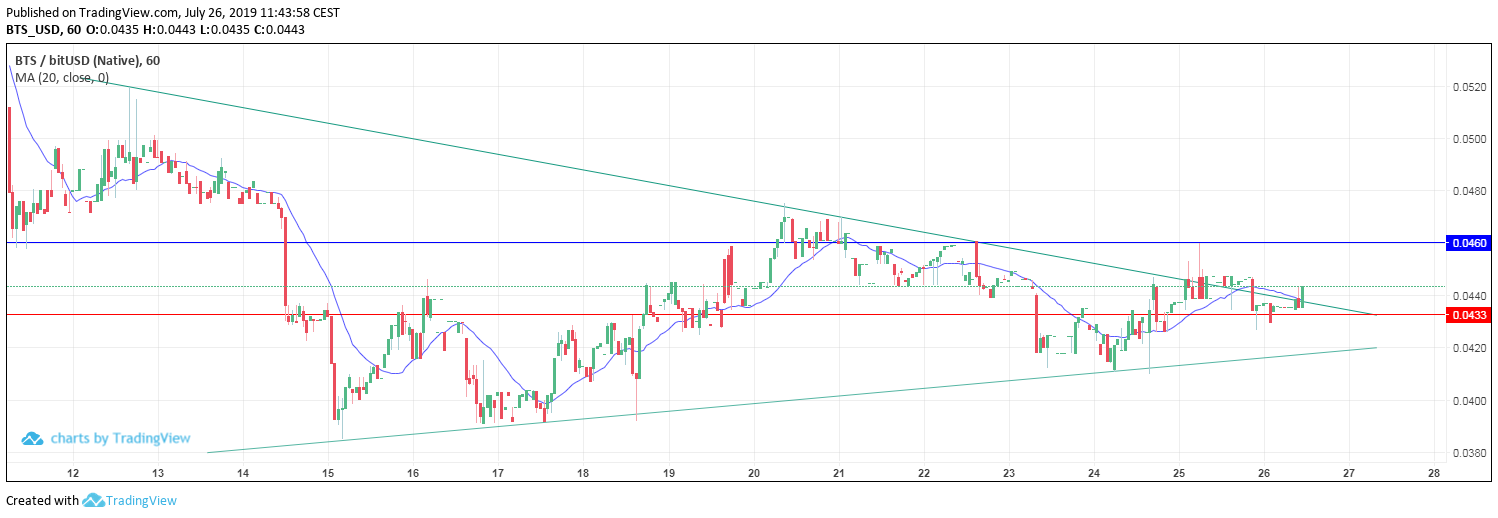
If there is an H1 close above the identified resistance block, a long trade may be opened. As this is a short-term strategy and we aim for moderate gains, the take profit target can be seen in the context of a horizontal resistance line (the blue line). The previous resistance block – triangle resistance + MA – is now seen as our invalidation level – a close at, or below this level, will close the trade.
This trade is in close to the recommended risk-reward (R:R) ratio of 2:1, as we risk around 10 pips to make 17.
The Hammer candlestick pattern has proved to be one of the most effective short-term trading strategies. As the name itself says, the pattern is based on a candle that looks like a hammer – a long lower wick and a short body at the top of the candlestick with little or no upper wick.
This pattern occurs in a bearish market. The formation of the hammer candle suggests the market is trying to create, at least, a short-term bottom. What usually follows is a strong push higher. The second candle that follows the hammer candle should be a strong bullish candle, also pointing towards a market reversal.